Any sales or marketing professional would know that companies tend to handle mountains of customer information, which have to be securely managed and should be easily accessible. This is where the role of different Salesforce integrations comes in.
According to the Connectivity Benchmark Report 2023 by Mulesoft, an organization uses 900 applications on average. The numbers might keep increasing as every company has different departments, and every department uses multiple applications to manage its activities. Using apps could be a way to manage work, but looking into multiple apps could be daunting when you have to find relevant data.
Sales and marketing teams need to continuously access and work with customer data, such as email campaigns, purchase histories, or engagement details. Integrating all these applications with Salesforce is the solution here to access applications within the CRM and make data-based decisions without switching to another screen.
In this blog, we’ll learn more about Salesforce integration while uncovering the top 8 integrations you shouldn’t miss if you want your sales and marketing efficiency to improve.
Considering Salesforce integration is a way you can decrease the workload of your team by connecting applications that are highly used within your organization. It enables teams to access all data from different apps in your CRM, making workflow easier.
Let’s understand the main types of integrations you can work with:
Native integration: Integration using the CRM solution
Third-party integration: Integration built using an external solution for data integration, for example, Zapier.
But you don’t have to stress how you’ll pick the right integration type. Experienced Salesforce integration services will do it all for you.
Salesforce integration, done right, can bring a real difference in the performance of your sales and marketing agents. Specifically, some integrations are highly likely to simplify workflow and boost team productivity. Here are these top 8 Salesforce integrations that you should consider:
1. Linkedin
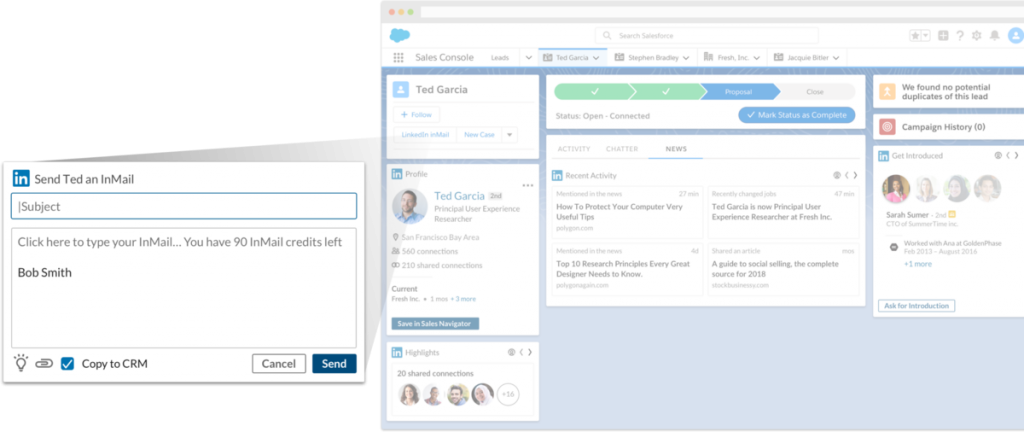
Integrating your Linkedin profile with Salesforce can help the teams identify their potential leads and can prioritize them. Salesforce Linkedin integration would help in decreasing manual lead searching and entry effort.
The integration can be achieved by synchronizing Salesforce records with Linkedin Sales Navigator. The integration would enable you to manage your LinkedIn contacts and send InMails from Salesforce.
2. HubSpot
If your sales and marketing teams are actively using HubSpot marketing, integrating the platform with Salesforce would be a game-changer. HubSpot and Salesforce integration would enable both teams to work in parallel. Bidirectional synchronization would enable both teams to update and access information in real time.
3. DocuSign
This integration allows you to run your electronic signatures and generate documents from Salesforce which can easily be shared with your accounts. These documents can easily be saved into your records. Also, you’ll be able to access real-time reporting from DocuSign within your Salesforce.
4. Mailchimp
Emails are definitely the most trusted means of customer engagement for sales and marketing teams. That’s why email marketing is always a priority for companies using Mailchimp.
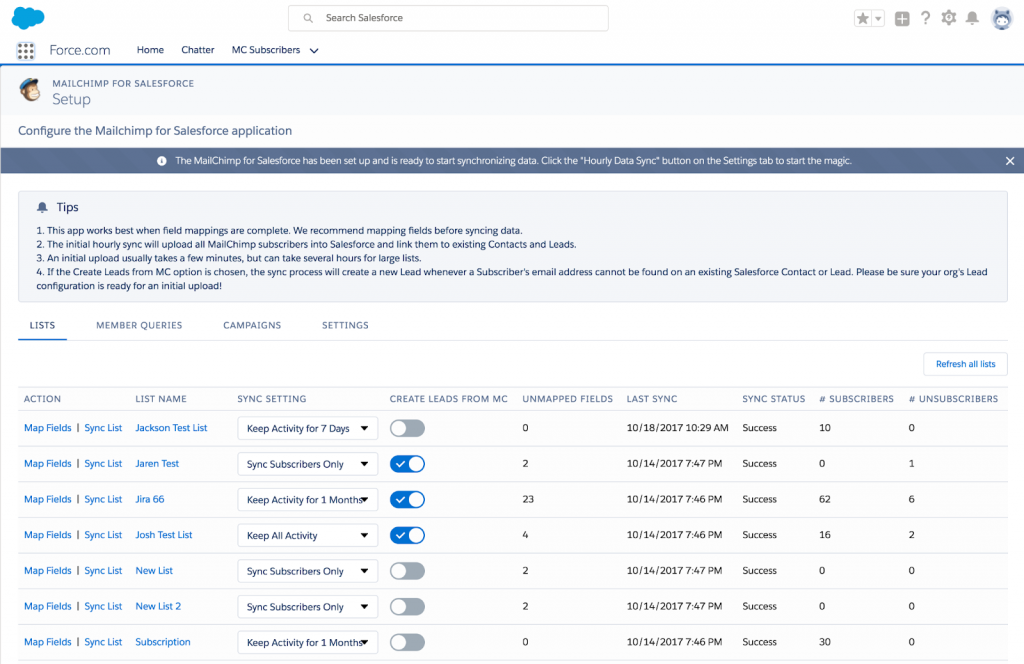
Integrating Salesforce and Mailchimp would allow teams to synchronize the solutions, enabling them to manage email lists and contact details on a single view. The integration allows the creation of email campaigns from the Salesforce org. Also, Mailchimp Salesforce integration allows teams to work on list segmentation within Mailchimp that will be synchronized with the lead and contact records in Salesforce.
5. Calendly
It’s the simplicity of Calendly that has made it so popular call-scheduling solution for almost every sales and marketing team. But its efficiency gets even more enhanced when you integrate it with Salesforce.
The integration allows you to create new call scheduling and book meetings while using Salesforce only. It will allow you to track your Calendly schedule from within Salesforce. This will thus give the sales and marketing teams the ease to book and manage calls within Salesforce without having to switch systems.
6. Quickbooks
Running sales and marketing campaigns also comes with efficient bookkeeping to manage expenses. That’s where Salesforce Quickbooks integration can be of great help. It will provide teams with complete transparency on business operations, financial details, and needed improvements.
Connecting Salesforce with Quickbooks will help to cut down any possibilities of accidental duplicate entries and will also reduce manual intervention, thus making accounting easier. All of this will help teams to manage operations better and get more tasks completed.
7. Slack
If your teams have been using Slack for internal communication, integrating it with Salesforce is a great idea. Conducting the native Salesforce Slack integration would not require any coding knowledge. This enables you to access notifications, work on approvals, and track screen flow directly in Slack.
You can even go for an API integration if you need to do more, like messages between Slack or Chatter.
8. Dropbox
Achieving Dropbox integration with Salesforce would enable you to access the information from your Dropbox directly within Salesforce. It allows you to conduct real-time editing of documents, syncing the changes across all the respective users.
The integration would thus boost the team’s efficiency, enhancing the ability to edit and approve through a centralized platform without having to switch their systems.
Although there are numerous other Salesforce integrations possible, these 8 integrations have caught most of our attention due to their high popularity. There’s no denying the fact that integrating your external applications with Salesforce will cut down a lot of your manual labor to save you time that you could devote to getting more done.
Now if you are still using Salesforce and your external applications separately, it’s your cue to get started with our reliable Salesforce integration services. You can contact us to discuss your integration requirements and take our hand to achieve enhanced productivity.
Different industry segments have benefited from Salesforce implementation; the same is true with nonprofits. For a nonprofit organization, the key is always to bring in donations to work towards a respective cause, and that’s what program managers and fundraisers keep working for. That could all become easier by leveraging Salesforce customization with the help of professionals.
According to the Nonprofits Trends Report 2022, only 12% of nonprofit organizations globally can be considered to be “digitally mature”. These nonprofits are able to leverage data in a better way to improve decision-making, forecast funding income, and personalize communication with donors. Only these nonprofits that are digitizing are 4x more likely to reach their goals. Along with this, these organizations are twice more likely to achieve the desired improvement in their operations.
With Salesforce customization, nonprofits are leveraging the power of using Salesforce to its full potential, utilizing its features that could help with fundraising through effective campaigns.
This blog would act as a guide for program managers and fundraisers at nonprofits who seek to improve their operations and campaign performance by customizing Salesforce for nonprofits. We’ll be talking about the following:
1. Importance of leveraging Salesforce customization for nonprofits
2. What is Salesforce Nonprofit Success Pack (NPSP)
3. Tools for nonprofits for better performance
So, let’s get started.
The idea behind Salesforce customization is to implement a tailored Salesforce solution that aligns well with the goals of a specific business. For nonprofits, leveraging Salesforce customization can bring wonders.
With Salesforce customization, nonprofits would be able to work with a custom solution that is designed specifically for them, considering the uniqueness of their mission and the cause they’re working for. Here’s what a customized Salesforce solution would enable you to do that would make it important to consider.
Customize donor database: You’ll be able to customize your donor database, enabling the team to add custom objects, fields, and relationships easily.
Access personalized reports: You can create personalized reports and dashboards to track the performance of your campaigns. You can even share those personalized dashboards with volunteers, staff, and the board.
Program management: Customizing Salesforce would allow you to access a program management module specific to the fundraisers you’re running to track the performance.
Work with pre-built email templates: With a customized solution, you’ll be able to access pre-built email templates specific to your nonprofit mission goals, enabling you to personalize them according to your donor segments.
NPSP is a free solution by Salesforce, specially curated for nonprofits, which helps to organize and manage fields and objects according to the needs and goals of the organization.
With the help of the Salesforce Nonprofit Success Pack, nonprofit organizations are able to access all those features and functionalities that relate perfectly to a nonprofit mission. You can implement a customized Salesforce solution and work with the free NPSP and acquire access to all features that could help your nonprofits to run better fundraising programs and achieve your mission.
As you choose to customize your Salesforce solution, there are also other tools that you can integrate with your customized solution to boost productivity and streamline fundraising operations.
Being a nonprofit organization, you’d surely be using different applications, whether it is for event management or donation campaigns. With Salesforce customization services, you’d be able to integrate these solutions together and easily access them within your Salesforce instance. This will save you a lot of time that you might have been spending switching between apps to find the right information and make suitable decisions.
Let’s have a look at these tools that will take your productivity and the performance of your campaigns off the chart.
Event Management
You can integrate tools for event management that enables teams to prepare for an event, schedule events, send invites, and set reminders. Integrating these tools with Salesforce will enable you to do it all from your CRM, along with easy tracking of the performance and results of your events.
Marketing and Fundraising
Teams at nonprofits can use multiple marketing and fundraising tools to enable peer-to-peer fundraising from their Salesforce org. This will not only help them raise money but will also expand the donor base to increase the probability of more donations. The supporters of the cause could set up their own fundraising pages and work to raise donations on behalf of your nonprofit organization.
Donation Tools
You would surely be using different donation tools online that would help fundraisers to gather funding to achieve the nonprofit mission. Integrating these donation tools with Salesforce would enable your program managers to run the fundraising campaigns that would be powered by Salesforce.
By far, you would have clearly understood that the benefits of Salesforce are not limited to businesses that are seeking more profits. The Salesforce CRM can also bring in a transformation for nonprofit organizations. From efficiently managing fundraising campaigns to bringing in more donor attention, a customized Salesforce solution can help your nonprofit to achieve the smoothness in your operations that you have always been seeking.
Salesforce is the best CRM that could revolutionize the way nonprofits have been operating, bringing in the kind of attention that organizations seek. With Salesforce customization and features of NPSP, nonprofits can leverage the power of the best features that could streamline their workflow and enhance performance. Contact us if you want to know more about how you can use Salesforce to improve your fundraising programs.
The Chief Information Officer or the CIO of any company always remains keen to bring new technologies to ensure effective data management. It is crucial for companies working in the IT sector to meet their clients’ expectations when delivering a suitable product. And to achieve that and sustain such a level of competitive advantage, companies are actively working on adopting new technologies that could help shorten the product development life cycles and enhance customer support. With this approach, many organizations have taken help from a professional Salesforce integration partner that could help them leverage the power of CRM.
According to the State of the Connected Customer in 2016 by Salesforce, more than half of the customers surveyed said the recent technology had changed their expectations of how companies should engage with them. The numbers clearly state that it’s time for companies to improve their IT strategy to improve operations and enhance customer engagement.
Before you think of the IT strategy, the key element behind it that needs much focus is the data maintained by the organization. What a company needs is the ability to have better control over the customer records along with getting the ease to access them quickly whenever needed.
With the growing technologies and customer demands, there are many challenges that companies these days are facing, such as:
1. Tailoring efficient roadmaps for companies for their application architecture.
2. To decipher and acquire just the right set of data needed from the huge data records.
3. Reaching the current B2B demands.
4. Providing recommendations on the best practices that customers can follow.
5. Identify issues in the businesses and conceptualize suitable IT solutions for them.
6. Coming up with suitable recovery plans when needed.
All these issues can be challenging to handle when the team doesn’t have the right technology support. That’s where having Salesforce CRM integration with other third-party applications would bring all the data together to make faster decisions and build better solutions.
Companies working in the IT sector have a lot to handle, whether it is developing solutions to designing websites. The more work team would be handling, the more will be applications that they had been using to streamline that work.
Although applications would be implemented with the idea of reducing manual work, the time involved in switching between those applications to find the right information can be frustrating too.
This is where having professional Salesforce integration partners can make a real difference for the team, enabling them to integrate all applications with Salesforce and access all information with their CRM only.
Let’s go a little deeper and understand how Salesforce integration can help enhance the overall IT strategy for companies while adding to productivity.
When marketers at firms want to get top of their marketing game, they need to have good control over the customer records through which they can personalize their marketing campaigns. That’s something Salesforce integration services make possible by bringing all applications together to get a common view within Salesforce. It would provide teams with a 360-degree view of customers to run campaigns that could meet the expectations and requirements of different audience segments.
When discussing digital transformation, we need to prepare the company for future opportunities and keep working on its expansion. Integrating Salesforce with other systems would help to automate processes and business models for the company, thus enabling the team to access features like lead assignment, forecasting, invoicing, and quoting. Not only this, but you can also leverage platforms like Pardot, Sales Cloud, Service Cloud, and other Salesforce-powered project management features to accelerate the digital journey of the firm.
When teams have access to all information on a centralized platform, it becomes easier for teams to stay updated on customer records. It even enables them to share files with each other or transfer cases or projects while easily catching hold of the complete customer journey so far. This makes it easier for everyone to stay on the same page when interacting with customers and delivering the expected solution.
Salesforce integration would help teams get all the data in one place, making it easier to use Einstein Analytics to get real-time insights from that data. This would give the company the ability to understand customer expectations and requirements through which they can work on enhancing customer experience and reaching their satisfaction. Einstein Analytics would also be a great help to developers who can use the best insights and forecasting to build future-proof applications.
As a flourishing business in the high-tech sector, there’s no way you can afford to miss out on advanced technologies that have the power to take your productivity and operations to the next level. But as productivity is essential, so is the customer relationship. Salesforce is the CRM that would help you grow in both these aspects.
When you plan on moving ahead with Salesforce integration, your next move should be to get a Salesforce integration consulting team that can be trusted with your business and data. That’s the kind of trust you can get with our certified Salesforce professionals. Contact us to learn about the different Salesforce integrations we’ve successfully performed for different industry verticals.
How your sales representatives interact with your customers matters a lot, irrespective of what kind of business you are in. Customer engagement would be the deciding factor of customer retention, revenue generation, and growth the company will achieve in the market. Most often, it’s the telephonic conversation that can bring in real sales. And realizing this, organizations these days consider CTI Integration with Salesforce to give the sales team the power to conduct better engagement.
Think of a situation where a sales rep fumble while communicating with a customer or have to keep the customer waiting to redirect the call to another agent. Now these situations can frustrate a customer, which might lead to bad-mouthing your business, and that’s something you’d never want for your company.
You need the right tools to help your sales team improve customer engagement and keep them connected with the business. With CTI integration with Salesforce, your telephony system would be integrated with Salesforce, allowing you to make quick calls with customers while having all customer details and engagement history in front of the eyes.
Let’s start by understanding the features this integration can offer your sales team.
For the sales team, Salesforce CTI integration can bring in real support. It helps them to simplify customer identification and track all information even before picking up the call. This ultimately helps them to deal with customers efficiently.
These are some of the top features of the integration that could simplify the work for the sales team.
Automated Process
From call logging to call recording, processes can be fully automated, helping the sales team to cut down on manual intervention and focus more on engaging better with customers.
Quick Calling
Agents don’t have to keep looking for details and phone numbers to dial. The integration lets them have all data at their fingertips with automated dial pads, thus making click-to-dial with Salesforce possible, saving reps time.
Smart Tracking
From first-call resolution to dropped call percentages, Salesforce telephony integration can enable you to track insights to get an idea about different performance indicators to know how sales reps perform.
Agent Assistance
Sales representatives would get screen pop-ups whenever attending calls, thus having every information they need to improve engagement.
But exactly when does your sales team need to consider the integration? We’ve listed some signs that you shouldn’t miss.
Before making any decision, it is essential to know exactly when the sales team needs to consider Salesforce CTI integration. Here we’ve mentioned some signs that the sales team shouldn’t ignore.
If your sales team is facing a situation when reps are just stuck with resolving issues of the existing customers and unable to reach out to new customers, then something needs to be changed. Integrating Salesforce and CTI would boost sales while enabling them to reach new target audiences.
Your sales time might be connecting with customers on top of customers but are not able to convert any leads. It could probably be due to unsatisfied or frustrated customers who are not getting quick and suitable responses from the team. Salesforce CTI integration can be a solution to this problem.
Are you seeing that your sales reps’ productivity is continuously decreasing? That’s probably because of the complex and time-taking telephony and data management processes they have to handle manually due to the lack of CTI Salesforce integration.
In the absence of integration, your sales team would be witnessing long queues of customers in call waiting. That will just frustrate your customers, and you might even lose some of them. No customer would want to be on waiting when they need to get some issues resolved. So, that’s where you need to have Salesforce CTI integration to engage with customers and meet their expectations quickly.
Even if your sales reps are working hard, not being able to track their performance would just be considered walking in darkness. You need clear insights into how your sales reps perform and how many customers are satisfied by providing the right solution or service. Integrating your telephony system with Salesforce would clarify these parameters so you can always know what’s happening in your sales department.
When customers are on call, they don’t like being on waiting or on hold, and you need to look for all the customer history so you can engage with them the right way. For a sales rep, having all the essential details in front when engaging with a customer is essential. CTI integration with Salesforce makes it possible.
There are times when a call rep needs to transfer the call to another rep to engage with the customer, which can take a lot of time, making the customer wait. With the integration, the process can be time-taking. But with the integration, all reps would be connected over a centralized platform, making collaboration easier.
Getting your telephony system connected with your Salesforce CRM is a great way to get your sales team access to all customer data over a single platform, making it easier to connect with them over calls.
Having said all of that, if you’re still on the fence, doubtful to consider CTI integration with Salesforce, you need to talk to the best experts to get the needed clarity. Contact us and discover how Salesforce integration with CTI can get your sales game up, bringing you the results you’ve always expected.
Any business, whether from the retail sector or the manufacturing sector, has one thing in common: lead management. But despite how important it is to manage leads, it can be tough to do it efficiently, especially when you have many leads. There are many challenges associated with lead management faced by numerous companies. Fortunately, organizations can leverage HubSpot and Salesforce integration which can help overcome challenges associated with lead generation.
HubSpot is a trusted platform many professionals use for inbound marketing and sales to attract more customers and provide a relevant experience. With HubSpot, users can access many tools that could enable them to capture leads quickly and manage them efficiently to reach quick conversions.
But when you are using Salesforce too alongside, you might face the real challenge of managing both platforms simultaneously. Salesforce CRM integration with HubSpot is the most suitable solution to manage your leads through a single platform.
In this blog, we’ll focus on learning several challenges while working with lead management, and integrating both platforms can help overcome them.
You can never underestimate the importance of lead management for the sales and marketing teams. The teams must always work hard to bring in leads, prepare them to make a purchase, and close them quickly.
That’s where HubSpot Salesforce integration can help teams and their managers to bring in more leads, efficiently work on nurturing them, and close deals faster. There are many features that you can access with this integration. We’ve listed a few of those here:
1. Seamless Collaboration: Integrating Salesforce and HubSpot would help teams collaborate and work in sync effectively. The integration would help achieve real-time synchronization of information, activities, and progress while providing notifications. This means both marketing and sales teams can work together, bringing in leads with a collaborative effort.
2. Sales Pipeline Management: We all know Salesforce as an amazing platform for its capabilities of sales pipeline management. By integrating the platform with HubSpot, sales representatives can easily synchronize their contacts, ensuring all other teams can access the pipeline information and contacts.
3. Reporting and Analytics: Integrating the platforms would enable marketing and sales teams to access advanced reporting features. Even the managers can access the real-time insights associated with the performance of their team members, evaluating how well they are working with leads and where the scope of improvement is. Not only this but having access to real-time insights would also enable leaders to plan their upcoming strategies in the right direction.
4. Contact Management: HubSpot has proved to be an efficient tool for tracking contact interactions. Salesforce HubSpot integration supports contact management, enabling users can easily access all the engagement records within Salesforce, allowing sales reps to personalize the approach of customer engagement wherever required.
There’s no denying that lead management is one of the crucial activities that sales and marketing teams perform. They have to pay significant focus on converting more and more potential customers for the business as that’s the only thing that will bring in profits for the company.
But several challenges are associated with lead management faced by the teams daily. But with Salesforce API integration with HubSpot, teams can overcome these challenges and convert more customers efficiently. So, let’s look at some of these lead management challenges and how integrating Salesforce and HubSpot can be a great solution.
1. Lead Capture: The first step to bringing in leads is lead capture, and usually, teams face a lot of struggle to gather the right information about customers to personalize their approach. The integration will allow you to easily access forms and templates for landing pages to capture lead information.
2. Lead Nurturing: After capturing the leads, the next step is to make them ready to purchase, called lead nurturing. That’s where teams face issues in preparing content that could be valuable for leads and guiding them to the buyer journey in the right way. With integration, you can access lead nurturing tools of HubSpot, like marketing automation and email marketing, to plan your strategies in a personalized way.
3. Lead Scoring: With a huge volume of leads, it can be tough for teams to identify the most important leads and prioritize them accordingly. That is where the integration with the help of Salesforce integration partners can help them with lead scoring to prioritize leads by managing their score based on their readiness to make a purchase.
4. Lead Segmentation: Not all leads are like one another. This is why teams face difficulty contacting leads with the relevant offer and content. Integrating HubSpot with Salesforce enables teams to segment leads based on their behavior and demographics, thus enabling them to set up a personalized strategy for each segment.
5. Lack of Collaboration: In many circumstances, marketing is sales teams are known to work in silos that restrict their productivity and growth. Integrating Salesforce and HubSpot will provide teams with a unified platform, enabling them to work together and access synchronized data in real-time to make better decisions.
With everything we’ve mentioned above, it’s quite clear that integrating HubSpot with Salesforce can improve the lead management game for both sales and marketing teams, enabling the leaders to have better track of data and improved results. Whether facing lead capture or nurturing challenges, the integration solves all your lead management woes.
Now you know the solution to your problems, the next step is to find the Salesforce integration consulting service that could get this integration done smoothly. Contact us and uncover the different Salesforce integrations we’ve performed successfully and given businesses the desired results.
We all know about Salesforce as a customizable platform that can be easily integrated with numerous third-party applications and software businesses use. It’s the Salesforce integration that can enable companies to maximize control over data while extracting the best of CRM features. But to get such benefits, you need to be able to leverage the best Salesforce integration tools to make your integration successful.
Salesforce integration undoubtedly benefits businesses, but achieving it can be tricky. That is why having the support of trusted Salesforce integration partners is necessary.
Not only the right partner, but you’ll also need the right Salesforce integration tools and platforms to help you integrate your CRM with existing applications efficiently. In this blog, you’ll uncover the top 10 Salesforce integration tools that could simplify the process of Salesforce integration.
The right tools can bring in just the right results regarding Salesforce integration. You need access to suitable tools to efficiently integrate your Salesforce CRM with external applications.
So, here are some of the top Salesforce integration tools you must have to achieve successful Salesforce integration.
Dell Boomi is one of the most sought-after and trusted tools for performing Salesforce integration. The tool enables you to work with a scalable platform to efficiently handle complex processes and a huge volume of data.
Usually, the companies that have data to handle from different departments tend to use Dell Boomi. Whether it is Microsoft Dynamics or Google Cloud, any such application can be integrated with Salesforce using this tool, as it is built for optimizing cloud-based platforms that support complex architecture. It supports an interactive and visual interaction to facilitate end-to-end integration.
RapidOnline is a tool that can be used for integrating Salesforce and Microsoft Dynamics 365. The tool has pre-configured templates and a user-friendly interface, making the integration process fast and efficient.
The tool offers built-in integrations that allow for customization to fit your specific integration needs.
Jitterbit is well-known in the industry for its efficient Salesforce integration capabilities. It is an integration tool that offers various API integrations based on the business size.
Depending on the number of systems you wish to connect to and the required support level, Jitterbit offers three service levels.
Jitterbit stands out as a preferred Salesforce integration tool; after all, it caters to technical and non-technical users. The platform can be used even without extensive coding or programming knowledge.
Commercient is a cloud-based tool that connects ERP systems with CRM solutions. It enables businesses to establish an efficient link between ERP and CRM to streamline business processes and establish strong customer relations.
One of the main advantages of using this integration tool is that it eliminates the need for manual mapping, ETL, or coding when integrating Salesforce. This helps to reduce integration costs and frees up resources that can be redirected toward other productive areas of the business.
When discussing the best Salesforce integration tools, you can never leave MuleSoft out of the list. MuleSoft is an automation and integration tool highly trusted by Salesforce users and has been a pioneer in the industry for a while.
MuleSoft’s Anypoint platform is owned by Salesforce and enables effortless integrations with various apps and services.
With MuleSoft, large businesses can maximize functionality and seamlessly integrate various departments. It also allows users to integrate multiple applications or services simultaneously.
Apache Airflow is a widely used integration tool that assists in authoring, scheduling, and executing workflows. It includes a variety of command-line utilities that make it easier to perform complex tasks.
Furthermore, its user interface offers numerous features that allow for the visualization of pipelines in production, project progress monitoring, and troubleshooting any issues to ensure successful project execution.
SnapLogic provides an integration platform as a service (iPaaS) that links on-premise business modules, SaaS components, and cloud data sources. It is an AI-powered platform that offers intelligent deployment options to businesses of all sizes.
SnapLogic automates the entire integration process, including the creation, maintenance, and deployment of projects in hybrid systems that are cloud-based and on-premise.
One of the primary reasons why SnapLogic is highly preferred is its easy accessibility. It makes recommendations based on machine learning to create end-to-end integration pipelines that align with user intent.
Workato is a cloud-based integration platform that enables businesses to link their applications, data, and processes across the organization. It has been developed to provide a fast and easy integration solution for cloud-based applications, such as Salesforce, with minimal coding required.
It helps organizations streamline their processes, improve data accuracy and consistency, and increase efficiency by automating manual tasks and eliminating the need for manual data entry. With the right Salesforce integration company, businesses tend to leverage the tool for performing the integration.
Fivetran is a tool for integrating data that emphasizes process automation. It is an automated tool that offers connectors, analytics templates, and transformations that can be used immediately, with the ability to adapt to changes in schemas and APIs.
Businesses worldwide use Fivetran to integrate data from event logs, cloud-based applications, and databases.
Cloud Elements provides developers with a cloud-based API integration platform that simplifies the process of connecting, managing, and publishing APIs via a unified platform.
It also allows developers to synchronize data between various cloud services, including Salesforce, Quickbooks, and Zendesk integration, using Cloud Elements’ integration toolkit.
All the above-mentioned tools and platforms can transform the process of integrating your Salesforce org with the third-party applications you use.
With the right tool and the help of trusted Salesforce integration services, achieving successful CRM integration would seem to be a piece of the cake. Contact us and get the right help to get your external applications integrated with Salesforce.
Are you tired of your service agents juggling between different tools and systems while managing customer interactions? Do you want to empower your agents to deliver exceptional customer service and leave a lasting impression on your customers? Look no further and consider Salesforce CTI integration for your service agents.
If we talk about recent times, customer service has not remained just a need or a functionality. It has now actually become a differentiator which can provide companies with a competitive edge. How efficiently you are able to serve customers can be a big deciding factor for the failure or success of a business. And to use the odds in your favor, Salesforce CTI integration can be of great help to you.
CTI integration provides your customer service representatives with the power to efficiently handle outgoing and incoming calls and messages and chat with customers over multiple channels in just a single view. Thus, this integration proves to be of significant help to improve productivity while cutting down the response time to solve customer queries.
With this blog, we’ve come up to take you on a ride that will enlighten you about Salesforce CTI integration and how you can’t afford to miss out on this amazing feature that could transform your operations.
So, buckle up and get ready to unleash the true potential of your service agents with Salesforce CTI integration. It’s time to elevate your customer service game and stand out from the crowd!
CTI integration for Salesforce connects a company’s telephony system with Salesforce’s customer relationship management (CRM) platform. This integration enables service agents to handle incoming and outgoing customer interactions from a single interface. It allows them to access relevant customer information in real time, make notes, update customer records in Salesforce, and perform other tasks without switching between different systems.
CTI integration typically uses a softphone, a software application that enables agents to make and receive calls through their computers instead of a traditional phone. When a call comes in, the softphone automatically pulls up the relevant customer information in Salesforce, such as past interactions, purchase history, and preferences, enabling the agent to provide personalized and efficient service.
Salesforce CTI (Computer Telephony Integration) integration can be very helpful for customer service agents in the following ways:
With CTI integration, incoming calls are automatically routed to the appropriate agent based on the caller’s history and issue, reducing the need for manual call handling. Such features would enable your reps to manage maximum calls in less time frame, thus resolving issues for more customers and leading to enhanced satisfaction.
With CTI integration, support reps would have the ability to dial outbound calls from Salesforce only. This can be made possible with an easy click-to-dial interface to cut down time and the probability of errors related to manually dialing customers’ phone numbers.
With this integration, you can also access dashboards and reports that will provide some real-time metrics to analyze agents’ performance, call volumes, and other KPIs. This can help managers identify improvement areas and adjust staffing levels for optimal efficiency.
CTI integration can automatically route incoming calls to the most appropriate agent based on various criteria, such as caller information, issue type, agent availability, and skills. This can reduce wait times for customers and improve the overall efficiency of the call center.
With CTI Salesforce integration, calls can be routed to agents with specific skills or knowledge related to the customer’s issue. This can improve first-call resolution rates and reduce the need for call transfers or escalations.
Customer service reps also get the ability to efficiently handle call queues with CTI integration. This is possible as the integration helps to prioritize calls according to the criticality of the problem and the urgency. Along with this, reps would be able to access the number of calls in waiting to estimate wait times and communicate the same to customers to manage them efficiently.
With this integration, representatives would be able to uncover the use of call recording that significantly help in assuring the quality of service being delivered. This enables them to efficiently review the service and achieve accurate feedback on the same. This helps agents to identify their areas of improvement and how they can do better in their respective job roles.
Customer support agents could access and evaluate call analytics with this Salesforce integration, making it easier to track different metrics. This would be of great help to support managers in knowing the patterns in customer interest and behavior along with the performance of each rep, making decision-making easier.
The integration of CTI in Salesforce enables agents to utilize a chat interface for collaboration and teamwork with other agents. This feature can be especially beneficial when an agent requires assistance from a colleague to help a specific customer.
This kind of collaboration among agents would be of great help if there is some complex issue and multiple agents have to work together and share customer data with each other. Salesforce telephony integration thus makes it easier to resolve customer issues in a single call without having customers wait or call again to get in touch with any specific agent.
When it is about boosting the productivity of service agents, Salesforce CTI integration has a major role to play in it. With numerous features like easy call logging and recording, screen pop-ups, and routing, agents can handle multiple customer queries easily while saving time and improving customer satisfaction.
Along with this, the integration also allows agents to get real-time data related to customer behavior and interaction. This enables them to customize the service according to each customer, thus improving relationships.
Therefore, investing in Salesforce integration services is a smart move for any organization looking to enhance its customer service capabilities and drive business growth. Contact us to learn how you can empower your service agents to improve productivity with Salesforce.
Salesforce has grown from being a reliable CRM solution to offering different tools and clouds to help our businesses with different functionalities and customization features. Its ability to connect with different parts of the business makes it more efficient, for which there are many off-the-shelf connectors for Salesforce to help users.
With Salesforce integration consulting, users connect their external and third-party applications with their Salesforce org. This ultimately makes this easier for them to access information from any application within Salesforce.
Off-the-shelf connectors for Salesforce simplify connecting standalone systems or applications with Salesforce, thus making it easier to share information.
Let’s look at some of these popular connectors that help with Salesforce integration and understand their functionalities.
With Slack becoming a member of the Salesforce family, it has become important that Salesforce and Slack should have an efficient connection between them.
There are different aspects, like the ability to search records while you send a message on Slack, which helps to maintain an efficient cross-team collaboration. This mainly helps when you have complex Opportunities and big Accounts. That’s something Slack Connector makes possible.
This connector enables you to share updated Salesforce information over messaging on Salesforce. It also helps to ensure that users get notifications and alerts without looking into Salesforce.
This connector is a managed package you can install in your Salesforce org. Marketing Cloud Connect help Salesforce users to work with both Salesforce Campaigns and data and the Marketing Cloud digital marketing capabilities.
Currently, Marketing Cloud Connect is not available for Lightning. If you try to access it in Lightning, you’ll be redirected to Salesforce Classic.
Even though the connector is not available for the Lightning interface, Salesforce has taken extra measures to ensure all steps of the journey are covered with the integration. Salesforce helps take you through all important aspects, whether just a prerequisite checklist or testing.
With the help of Pardot Connector, Salesforce users can use APIs to send Salesforce data to Pardot. This is possible by synchronizing between the systems every 2-4 minutes. Since the sharing pattern between Salesforce and Pardot is quite unique, Salesforce users need to discover what data can be synchronized when connecting the systems.
How you set this connector depends on the way the respective users want to use this integration. But before starting the work with the connector, the user must set the right Salesforce permissions.
If we talk about the partnership between Salesforce and Tableau, it goes way back, even before the actual acquisition of Tableau. Salesforce users always had a way of integrating these two systems, which kept getting better with each release.
This connector to integrate Salesforce and Tableau can be accessed with Tableau Desktop and Online. But along with this, there’s a ‘quick win’ that is free and readily available for users.
It can be fun for a Salesforce Architect to integrate Salesforce with the applications a business uses. But the process is not as easy as installing an app from AppExchange. What options could be used if a connector or a managed package is inefficient for conducting the integration?
The key to success here is to combine one of the MuleSoft Salesforce Connectors with any third-party system within the Mule Integration app.
Integrating your apps with Salesforce is something you can’t ignore when focusing on easier data access and enhanced usability. What you need here is a way that’s reliable and cost-efficient.
Bringing your third-party apps together with Salesforce would not be an issue when you find the right off-the-shelf connector. Contact us to get help from our trusted Salesforce consultants and find what connector would work well for you.