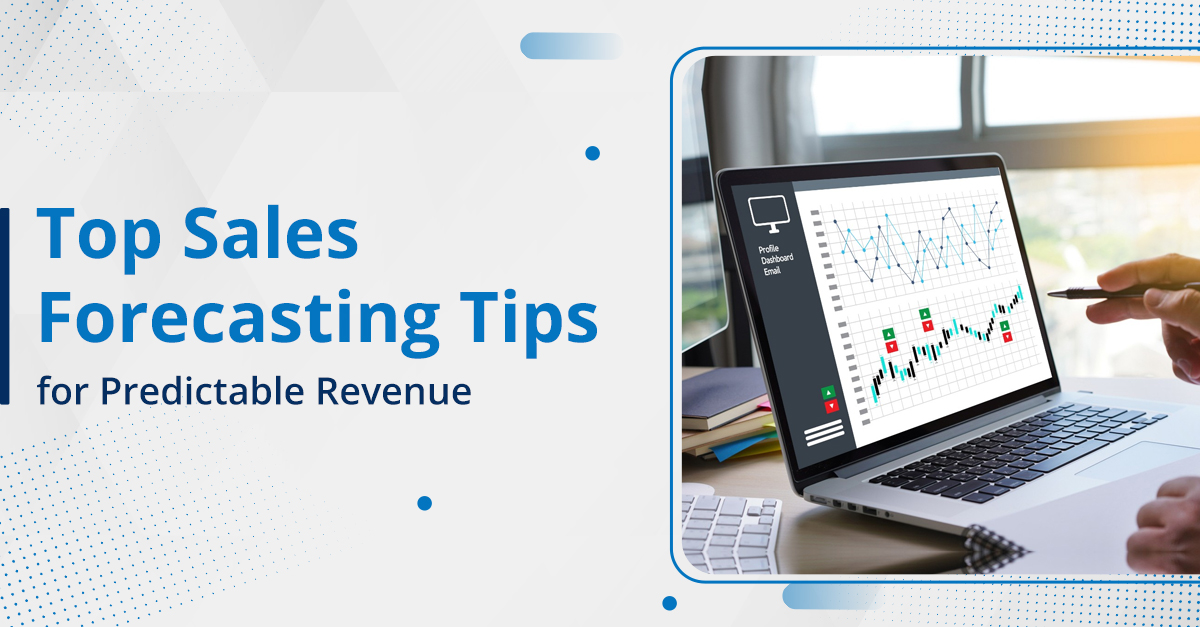
Predictable growth is helping businesses to achieve consistency year over year, and it is the forecasting where it all begins. Following the right sales forecasting tips is helping companies to make critical business decisions, manage budgets, plan the headcount strategy and investment, and know future earnings, thus helping businesses to set the North Star.
The right sales forecasting techniques can lead to predictable revenue and accurate, actionable data. The best sales forecasting techniques are able to provide answer these two simple questions: How much does the business plan to sell? And when will the business is going to deliver those numbers?
To help you better sell from anywhere, we have brought some tips that could be fruitful. It answers the most common questions we hear about sales forecasting from sales reps and leaders.
Your team should concentrate on these simple questions when building their forecasts:
You can also use your sales forecast to assess the current risk to your business, and this is called negative forecasting.
For example, you can add a COVID-19 field in Sales Cloud to tag deals and see the pandemic impact. The two key benefits of this approach will be:
Negative forecasting can help you gauge possible risks, thus making your forecast evolve with your business.
Every department relies on sales forecasts. Not a single part of the organization goes unaffected when forecasts don’t prove to be accurate.
For example, using the sales process business can prepare a plan to ship products, strategize marketing, and hire needed employees. Accurate forecasts help companies make better investment plans, like hiring a needed number of Salesforce developers or opening a new sales office in the prime territory if the requirement is identified.
On the contrary, if the sales forecasts are off, likely are the chances that the company would face challenges across all business functions – from pricing to product delivery. Everyone relies on the ability of the sales team to pull off an accurate forecast. So never underestimate the importance of your forecast.
Extreme weather, global pandemics, economic crisis, and any other such factor can be responsible to bring a dramatic change to your forecast. Even if you thought that you knew about expected revenue growth with Salesforce, all of it can suddenly flip within an instant.
This makes it important to track the accuracy of your forecasts with changing conditions and markets as you would never want to risk your strategy failing because of inaccurate forecasts.
A good sales forecast helps you make better decisions about the future. You just needed to know the right tips that can take you across. With accurate forecasting, you’ll know if you should prepare for a rainy day? Or will you just need sunglasses and smooth sailing?
Become a forecasting pro to put resources and energy in the right places so you can continue to thrive with the help of our Salesforce consulting services, offered by certified and experienced professionals.
For any company, data is the key to success. But for that, you need to know how exactly you could use all that data that you had been collecting. Even for senior leaders, consistently using data to make decisions could be difficult. This is where they need to work on instilling a robust data culture across teams to make that happen. It might sound easy but it’s definitely not.
How you can build a data culture in the company and cultivate it? How employees in different departments and on different levels can make good use of the data? These are just a few of the questions that can come to your mind when it is about creating a data culture.
Let’s give some emphasis on how you can actually work on creating a culture in your organization that revolves around data.
Always consider sharing these insights generously with partners, clients, and other third parties. This will help you to instill a transparent and outcome-based way of working in the organization. But that doesn’t mean you have to stand still with it.
Make sure you constantly evolve your thinking. It is important that you don’t shy away from evolving the way you have been approaching and using data. You can always use AI-enabled Salesforce Einstein to smartly capture data, access it, and use it.
When you’ll be able to embed this into different and effective ways of working for everyone, you’ll achieve remarkable growth using data-driven insight the way it should be used.
Every company wishes to have a data culture, but what’s unfortunate is that not enough people are asking the right questions about data. Why do you want to have a data culture in your organization? What are you trying to answer or achieve with data? What business problems can a data culture help to solve?
Teams should sit together and can probably come up with different reasons data matters to your organization, which could be different for different departments. No wonder taking action on those reasons might take a lot of time, but what’s necessary is to have the foundational questions that people make the mistake of skipping.
Spreadsheets are still most people’s tools for data. And that’s insane. Try to introduce your team to a data visualization tool, for example, Tableau, and show them how easy it is to build a dynamic interactive dashboard from any data source.
It is unfortunate that people don’t have a clue how easy this is. Just try it out and you’ll know it’s a far better alternative to spreadsheets to manage your day-to-day records.
Develop a company-wide data training curriculum. It is important to set a training curriculum to educate teams on new technologies and ways to use data wisely.
The training has to be thorough and should include a session in which all can discuss their queries and get a better understanding of the data culture. You need to dedicate some time to set up a curriculum that’s quickly accessible and easy to understand by employees in your organization.
The points above made it pretty clear how important it is to have a data culture in your organization and how you can actually work on having one.
Having such a culture would improve your hold on data, giving you an understanding of how to make better decisions using it. Try to inculcate it and if you need any help, contact our team of Salesforce consulting services for better assistance.