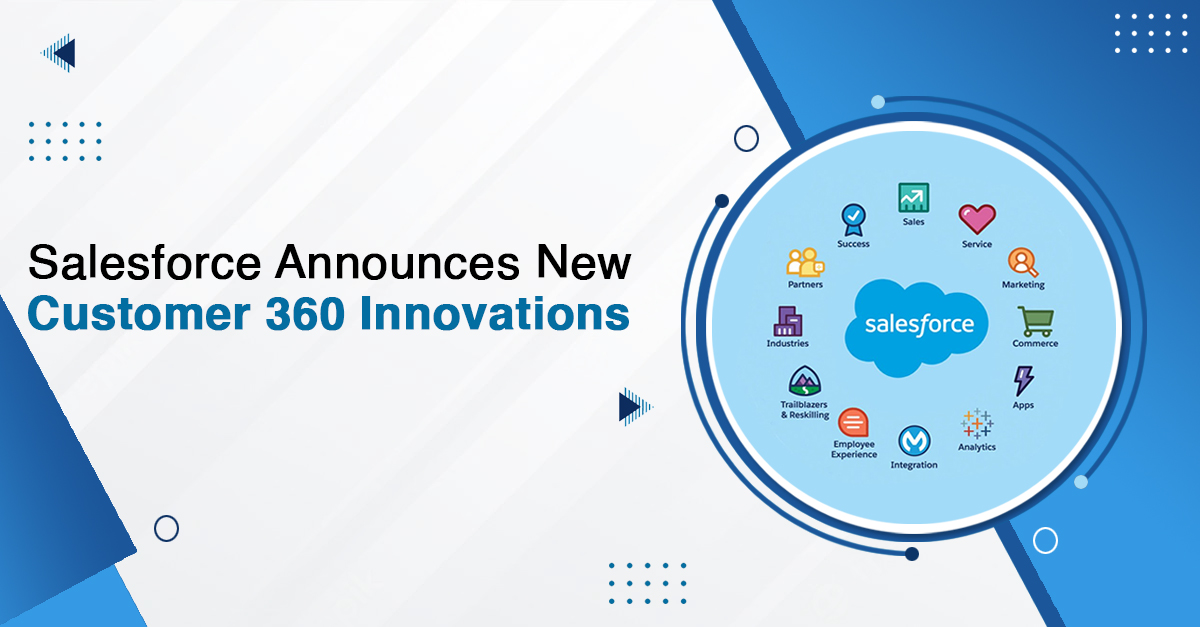
Salesforce recently introduced new Customer 360 innovations that help to connect, commerce, marketing, and service data on one platform so companies can personalize every single interaction using insights from different departments.
Companies these days face mounting pressure to do more with less, all while striving to meet the rising consumer expectations. Ongoing changes in data privacy laws make it difficult to meet those expectations, and we can expect a cookie-less future to be fast-approaching.
This is where it is important to implement the next-gen Marketing and Commerce Clouds to give organizations new ways to deliver unique, connected and personalized experiences.
Marketing Cloud makes it easy to humanize every interaction, making marketers more efficient. Let’s have a look at some of the recent innovations:
The feature helps bring together Marketing Cloud Personalization and Engagement to deliver personalized, 1:1 customer engagement based on behavioral triggers new product catalog. Organizations can utilize data to understand preferred products by customers and engage with them when they are back in stock or on any active sale.
This connector helps to combine orders and product data to gain insights into revenue, product, and sales performance over time.
Businesses using Marketing Cloud can now automate data integration and understand where to spend to achieve an increase in ROI across campaigns, channels, and products. For example, marketers will be able to see the number of orders placed during a promotion, or the top three products ordered from different demographics in real-time.
Brands can automatically connect their data from different departments in a unified customer profile. It will help them to plan efficiently plan and optimize their Google Ads campaigns.
With this capability, marketers can deliver personalized campaigns using the first-party data they have instead of cookies. Also, in the near future, marketers can incorporate segment-level insights into the interface of the Customer Data Platform.
This is the app that unifies a company’s commerce and marketing data. It enables marketers to access it all on a single platform, using actionable insights to generate interactive dashboards.
Here are some new features with which Commerce Cloud will bring a new approach to digital commerce:
Salesforce’s NFT Cloud, which is now in the pilot, can help businesses expand customer experiences to Web3 environments in a trusted and sustainable manner.
It can help you manage and sell non-fungible tokens (NFTs) directly on the Salesforce Customer 360 Platform and connect customer data securely to gain a 360-degree view.
With the help of Social Integration, businesses can create and automate product feeds, publish ads, and segment audiences while finding and targeting new audiences. They can even create TikTok ads that will redirect to their commerce websites.
Commerce Cloud will have new capabilities that give agents a complete view of order history across channels through which service departments can transform into revenue drivers.
The feature will give them the ability to issue exchanges, returns, promotions, or complete orders, without the need of transferring them to other departments.
Businesses can create, manage, and scale a marketplace solution quickly on Commerce Cloud. It enables them to extend their catalog range with products from other companies and reach new buyers and channels. This can help brands drive new revenue streams, leading to an increase in cart sizes and membership subscription fees from vendors.
All these enhancements could take your productivity and work efficiency to a great level. But make sure you get expert guidance on what features would be right for you.
Hiring Salesforce consultants would simplify your way to plan and work through these new Customer 360 innovations and maximize your capability of working with Salesforce.
Last year, Dreamforce conducted an all-virtual event, bringing the Salesforce community together despite the difficult pandemic situation. This year Dreamforce 2021 came not just virtually, but as a hybrid in-person/digital conference, with all its events streaming on Salesforce+, the new streaming services by Salesforce.
Dreamforce 2021 kicked off with the keynote speech by Mark Benioff, CEO of Salesforce, and Bret Taylor, COO of Salesforce. The event was started with a lot of enthusiasm, inspirational stories, musical guests, and a powerful discussion on how we can create more inclusive workplaces to deliver engaging customer experiences.
Benioff introduced everyone to the idea of Trusted Enterprise, presenting the responsibility each organization has towards its customers, employees, and the world at large, making it important to respond to the crisis of COVID-19 in a responsible way.
Salesforce wants to help companies find the solution to problems related to the pandemic, a struggling workforce, environmental sustainability, or inequality around sexual orientation or gender. Benioff mentioned the importance of digital headquarters with the recent Salesforce acquisition of Slack, which will be the building block of setting up a Trusted Enterprise.
Also, with Dreamforce 2021, a new Health Cloud 2.0 is introduced for the safety of everyone in the surrounding community with the Dreampass, enabling safety protocols against COVID-19 for in-person attendees.
Day 1 of the event continued with Bret Taylor sharing client stories about how companies are using Salesforce to make a change. The story of IBM was spotlighted, showing how the company is using Slack to migrate 350,000 employees from office to work from home setups. It was followed by the story of Mercedes-Benz building a customer-centric marketing experience with Customer 360 to gain more attention on their new range of electric vehicles.
Day 2 of Dreamforce 2021 started with a conversation between Soledad O’Brien and Salesforce Co-founder and CTO, Parker Harris. The conversation focused on the insights related to Salesforce’s past and future.
Moving forward, Accenture took over the main stage with Bryan Beruman and John Carney talking about the state of B2B sales and the changes observed with the pandemic. Carney shared the story of John Patterson of NCR related to the growth of B2B sales in the 20th century with all his principles. But all of that is changed now. With buyers changing and sellers increasing the need to respond, Carney mentioned the current B2B market as the “the new new.”
Dreamforce 2021 majorly focused on social justice and racial equality. In this context, Soledad O’Brien introduced 3 female Trailblazers black leaders: the award-winner Minda Harts, San Francisco Mayor London Breed, and the award-winner journalist Elaine Welteroth. They talked about the meaning of black excellence and how this state of mind is opening new doors to opportunities for black people to thrive in their community.
With the effort of tackling COVID-19, LaShonda Anderson-Williams, SVP of Healthcare and Life Science at Salesforce, talked about how technology is contributing to improving global health. It was mentioned that the world needs connected health for which a platform is required that would integrate providers, payers, pharma, MedTech, and public health organizations. The idea of a connected health ecosystem is to deliver a modern health experience. The emphasis would be on personalization to provide people with safe and accurate treatments.
Day 3 kicked off with Stewart Butterfield, CEO & Co-Founder of Slack, and Jennifer Tejada, Chairperson & CEO of PagerDuty, discussing how today’s leaders are driving more flexible, inclusive, productive cultures. Slack, in partnership with Salesforce, is enabling companies to connect with their teams easily in the work-from-home culture, maintaining one digital source of truth. Jennifer talked about Slack not only as a way to connect with her employees but also to democratize and flatten the overall organization.
Sustainable future and sustainability have been the trending topics during Dreamforce 2021 event. Salesforce utilized 100% renewable energy and achieved net zero emissions across its value chain, and purchasing carbon offsets when either of them was not a possible approach. Salesforce also scaled up its Sustainability Cloud to support better collaboration with suppliers while achieving industry-specific climate action plans.
Moving forwards, Rob Garf, VP & GM of Retail at Salesforce, talked about how people have switched to e-commerce during the last year. With customers at the center of businesses, retailers need to accelerate digital transformation to successfully meet the highly increasing demands. Salesforce Customer 360 helps to reduce friction across multiple channels, allowing retailers to analyze customers. Rob also gave an introduction on a Slack-First Customer 360 for retail demo in action.
And that’s it, folks! Dreamforce 2021 came to an end with amazing sessions, a fun-filled celebration, with many more advancements to help organizations grow digitally.