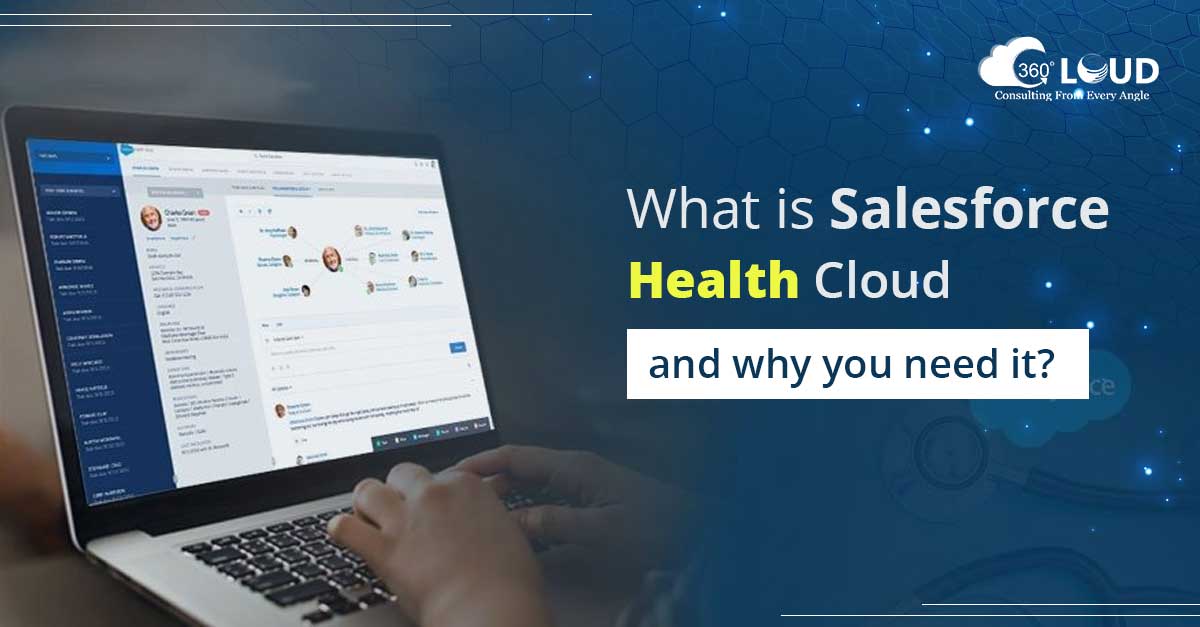
The health industry has become one of the biggest industries in the world. The reason is its tremendous growth and demand in recent years. With this growth came along the excessive workload that has been handled with trusted solutions like Salesforce Health Cloud that boosted operational efficiency.
In 2019, the global healthcare industry was valued at USD 282 billion and was expected to grow at a CAGR of 7.9% from 2020 to 2027. With this kind of growth, the need to have integrated systems to manage a multitude of data increases. That’s where Salesforce Health Cloud comes in. Let’s get a detailed understanding of Health Cloud.
Salesforce Health Cloud is a platform to manage the patient relationship built using cloud technology’s power and security. It also has the support of social and mobile technologies that help to offer better and personalized engagement to patients or other users.
Health Cloud can be considered a medical CRM for your healthcare organization. It provides the HCPs with a complete overview of the patient’s condition, their medical history and manages the patient smartly to deliver a connected patient engagement experience.
Using Salesforce Health Cloud, your staff can easily access the data of your clinical or non-clinical patients, including their health conditions, medications, appointment history, and preferences, by using EHR and other systems.
It is a highly secure platform, so you don’t have to worry about losing patients’ data. It lets you communicate on different channels or devices to improve patient relationships. It even allows you to use triggers and workflows to deliver and track care information in a better way.
With Salesforce Health Cloud, customers have a data model built around patients and designed mainly for clinical settings using the FHIR standards.
Here are some of the main features of the Salesforce Health Cloud:
It includes creating and managing profiles of the patient, their health timeline, and the patient care team network.
It includes prioritizing the patient page, collaborating with the care team, configuring patient setup, management & customization of the care plan, population analytics, patient lists, patient segmentation filters, Risk stratification, & lead to patient conversion.
It works on a clinical data model and enables EHR integration. Health Cloud has an HL7-compliant interface and an individual patient model.
Let’s look at some points that illustrate the importance of implementing Salesforce Health Cloud.
Health Cloud enables medical experts to provide the needed attention to each patient by providing individualized services. The patient can be assisted throughout the entire program.
Salesforce Health Cloud gives a comprehensive picture of the patient eliminating any data silos, security loopholes, inconsistencies, or service delivery delays.
It enables you to create simple and customized care plans to address any specific health concerns and provide the best possible solution.
A 360-degree picture of all patients’ views can be utilized to provide the most effective healthcare services. With just a few clicks, the current state of health, appointment history, medical history, medications used, and other vital information are provided in detail.
With Salesforce for healthcare, you can ensure that patients are always in contact with the healthcare staff. Companies can also connect to the private Salesforce community to acquire real-time healthcare advice for the convenience of patients and medical professionals.
You can conduct Salesforce Health Cloud integration with your current electronic health records (EHR) and get a centralized view of all tasks and goals along with the mapped treatment plans. It enables professionals to manage health records more efficiently.
With the platform, you can enable individualized patient interactions across many channels, including online mediums and phone, at each stage of the patient’s journey. The medical staff can even use it to answer the individual demands of patients in real time.
It is essential to tailor every encounter with today’s healthcare clients. Salesforce Health Cloud can offer this kind of experience. It gives a unified platform where patients’ and members’ experiences can be individualized while improving the respective processes.
So, consider implementing the same and for that, you need to hire a Health Cloud developer. You can contact us to learn about more features of Health Cloud before getting started with implementation.
With healthcare professionals adopting the right technology, a dramatic improvement in the care management approaches has been witnessed over time. From elevating the patient experience to analyzing the health records and making the right decisions, there’s a lot involved in the healthcare sector. Thankfully Salesforce Health Cloud finds itself capable of meeting these challenges. The Health Cloud is only among an increasing number of platforms that support a more engaged and tech-savvy patient base. Per Salesforce, 71 percent of millennials want to engage, control, and manage their healthcare actively. The Salesforce Health Cloud exceptionally satisfies these requirements.
Salesforce introduced Health Cloud as a patient engagement platform or ‘Healthcare CRM’ that connects to a treatment or Hospital chain’s existing IT system. Its capabilities incorporate doctor-patient relationships while offering record management services. The Health Cloud supports one-to-one relationship management through a patient profile, integrating information from multiple data sources, including medical devices and electronic medical records (EMRs). The primary benefit of Health Cloud is to improve visibility into the entire healthcare journey and systematize interventions.
With Salesforce Health Cloud, the way the medical data gets handled transforms completely. Here’s a look at how it helps medical establishments turn a corner.
#1 It unlocks operational efficiencies for busy medical staff from a unified platform
By enabling all stakeholders with access to critical data, enabling real-time collaboration and proactive engagement, the Health Cloud allows healthcare professionals to improve efficiencies to drive better outcomes. It allows care-teams to access the latest patient information and upcoming tasks, encouraging better adherence to care pathways. Similarly, pharmaceutical providers can drive awareness of patient support programs and track marketing and sales activity with the Health Cloud, which offers them an integrated view of all patients and provider interactions with them.
#2 Hospitals, labs, care facilities can consolidate progress across existing systems
With Salesforce Health Cloud, there’s no need to start again from scratch or undertake a massive effort to connect siloed systems and data. It layers on top of your existing systems and software applications and easily integrates with your current data. Health Cloud supports quick integration with electronic health records and claims management software, giving the team a comprehensive view of the healthcare journey of patients. It provides teams with a single view, eliminating the need to toggle among various systems and screens to find information about each patient.
#3 Treatment chains can deliver personalized care more productively
Salesforce Health Cloud pushes forward AI-enabled personalization for digital healthcare. After adding third-party data to the existing data in CRM, you can choose from several different use cases depending on your services. AI is used to surface the training resources for staff and helps in anticipating issues based on patient history. AI features supported by Health Cloud also use predictive analytics to identify at-risk populations and recommend next-best actions for greater engagement and timely intervention.
#4 Wellness & Therapy Clinics can capture preferences to build relationships & engagement at scale
Circling back to its core role as a CRM platform, the Health Cloud efficiently captures communication through a myriad of preferred channels – including live chat, phone, mobile apps, emails, and online forums. This helps the services to proactively engage with healthcare consumers, knowing the right time and the right way to establish contact. This CRM helps gather the data about the consumers, which can be further segmented to create contextualized engagements. This way healthcare practices and professionals have everything they need to stick to a consumer-centric approach right in front of them.
Although in-house legacy systems have been the heart of patient information for a long time, realizing they may not be the most efficient way to organize patient information opens up patients to novel tracks for care and prevention. Going forward, unoccluded and centralized patient data will be key to greatly simplify treatment planning, as treatments themselves become increasingly data-centric and even overlap with patient data to lead advances in treatment methodology.