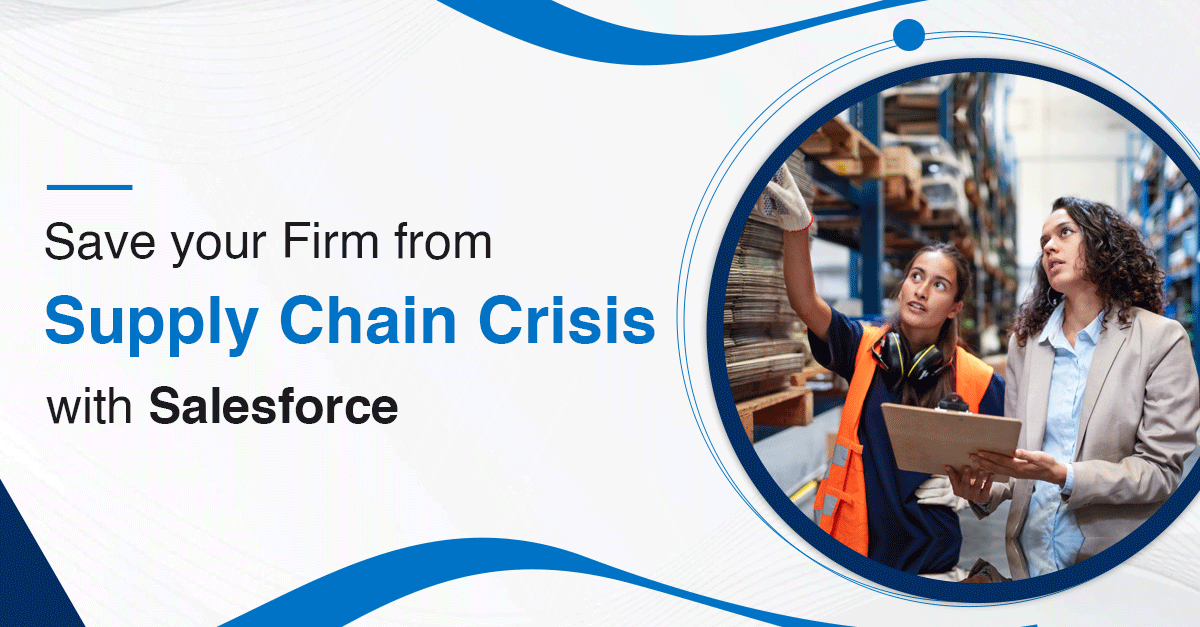
Empty warehouses, unhappy customers, and bare shelves are some issues that manufacturing companies these days have been facing. Even though achieving clear jam-packed ports is not so easy, still, there’s a lot that can be done to improve the situation. You just have to be prepared to save your manufacturing firm from a supply chain crisis and keep growing.
Customers are not concerned about things that are happening behind the scenes. All they want is their product to be available or delivered on time. That’s where you need to work on delivering transparent and proactive service.
We’ve listed here a few ways you can ease the impact of the supply-chain crisis on your customers while keeping up the revenue.
Since the pandemic, manufacturing companies have been facing supply chain issues. This makes it important for businesses to consider disruption to be the new normal.
They can implement Salesforce to leverage new processes, touchpoints, and checkpoints to shape next-generation digital investments.
Digital transformation should focus on including visibility and engagement systems that could help in winning customers’ trust and building customer relationships as a key to future growth.
With Salesforce, teams can focus on sharing data openly across different departments of a company, thus helping to connect data silos.
Maintaining transparency helps suppliers to communicate in-stock components for manufacturers in real-time. Thus, manufacturers would be able to make their decisions faster on production runs and inventory management.
Another way to tackle the supply chain crisis is to deliver proactive service. Consider a situation, a few days before the scheduled delivery date, you receive a text from the distributor that the shipment is delayed. You receive a new guaranteed delivery date, which can be shared with customers.
This may not be the perfect buyer experience but at least your customers don’t have to sit around wondering about their product.
Now suppose, you don’t receive any word about the delay and the product doesn’t arrive at all. Days go by and you receive no word. It will simply lead to customers canceling orders, rather than waiting any more. This makes delivering proactive service important.
You never know when a supply chain crisis can come to hit you. All you can do here is be prepared to save the firm. That’s where Salesforce can prove to be a great help for you.
Get in touch with our certified professionals to get customized Salesforce solutions for manufacturing businesses to manage your supply chain to avoid any delays in production or delivery.
Manufacturers can make the most of the exciting opportunity to augment distributor networks with their own digital commerce site. Choosing direct to customer (D2C) approach helps build long-lasting relationships with brands that customers crave.
And when done right, D2C can help to boost business growth. Studies show that more than half of people who visit a manufacturer’s website, intend to make a purchase. But before going direct-to-consumer (D2C), you should know that it comes with a lot of questions as you shift focus away from a strictly B2B model.
Let’s learn about some important tips that could help manufacturing companies make an easy move to the Direct To Customer (D2C) model.
Do some research to find potential channel conflicts and think about ways that could help you minimize them. It is important that you communicate your goals and D2C strategy with existing distribution partners ahead of time so you can strategize it all together. It will help to open the door to working together in new ways, gathering great ideas to reimagine channel management strategies, and building new partnerships.
When going D2C, these approaches can be helpful to you:
It is the content and experiences that help to bring consumers closer to your brand. Every measure you take should support the consumer journey. From discovery through loyalty, you should follow regular, personalized engagements that resonate with customers.
Your D2C channel will act as your hub to conduct engagements. You have to record and manage detailed product histories for each customer, descriptions, and how-to videos that could be helpful for customers.
The customer expectations keep changing, you need to make continuous efforts to meet those. Keep Innovating continuously so your engagements meet consumer and market needs in a better way.
Moving to the D2C approach van be a crawl-walk-run approach but it will all be worth it when it will keep bringing more value to the company. Just plan the Direct to Customer or D2C strategy right with certified experts.
Safely make the transition with our certified Salesforce professionals. Get in touch with our experienced Salesforce professionals to learn more about our services for the manufacturing industry.
Many research reports say that the global manufacturing sector has taken a hard hit by the pandemic. The manufacturing sector has been seen slow to adopt the technology. Only 57% of the manufacturing companies can confidently say that they are quick to adopt the changing market and technology trends. The rest still struggle. The need here is to adopt a connected manufacturing strategy in which Salesforce can be of great help.
There are many manufacturing companies that fail to quickly react to disruptions in technology. The reason behind this failure is the disparate legacy systems that end up creating asymmetry of information and data silos. Salesforce helps resolve it all providing a connected manufacturing approach.
Any typical manufacturing ecosystem tends to have a complex business process and operations that involve major challenges that need immediate action. Some of these challenges are:
All these challenges need to be resolved in order to ensure that a manufacturing business is growing while adopting technology change.
To achieve a connected manufacturing strategy, a company needs to improve data sharing and collaboration among teams and partners. Here’s how it can be done.
It is important to increase predictability in the manufacturing sector to identify changing market demands and align strategies accordingly. The sales team can collaborate with other teams to evaluate highly accurate forecasts based on the run-rate business. They can also automate manual tasks like quote generation and lead management to cut down the sales cycle.
The success of a manufacturing company very much depends on how its partner network sells. This makes it important to increase alignment with partners with a partner management solution that will simplify onboarding and incentive management. You can also capture real-time feedback on products from the field and identify more revenue opportunities. You can also provide partners with tools for self-service and performance tracking to align goals.
The best approach for manufacturing companies is to adopt Salesforce Manufacturing Cloud to future-proof manufacturing businesses and derive a connected platform to run and manage their operations. It will allow companies to:
Along with these, you’ll witness many other fascinating features that could increase the operational performance of your manufacturing business with better collaboration.
There’s no denying the fact that the manufacturing sector needs to keep evolving to walk parallel to the changing technologies and customer demands. The need here is to follow a connected approach to bring all departments together, enabling better collaboration. All you require is the support of a trusted team of Salesforce experts to get your manufacturing business running at its best. Contact us to learn more about trending technologies for the manufacturing sector.
Ongoing innovations in the manufacturing sector have inspired companies to digitize their operations and find ways to sell and track products online. The digitization of manufacturing businesses has made get ready to embrace large-scale change that would possibly come in the near future. And the idea behind this is to future-proof manufacturing businesses by making the right use of data gathered through systems.
Factors like customer-centricity and agility have never been more important for manufacturing companies. Whether it is improving marketing strategies or volume pricing or planning, everything needs to circle around customers. And the best way to do that is to use data to understand and serve customers better.
Data is an asset for any company. For a manufacturing business, it is the key to analyzing customers, suppliers, material, and productivity. But to make the most of it, companies should know how exactly to use it for future-proof manufacturing businesses.
For years, manufacturing companies have been making product-centric investments focusing on proving production, quality, and supply chain. But it’s time to give equal attention to end-to-end customer experience. The key to getting more closer to customers is to know them and for that, you need to track data in a single view.
Future-ready manufacturing companies use a single source of truth like Salesforce CRM that helps to integrate employee and customer interactions. This helps to remove divisions across manufacturing companies and keep different departments aligned on the same platform and data.
When it comes to the manufacturing value chain, channel partners are the key members. Thus, manufacturers have to work on engaging partners in ways that could result in driving more loyalty.
The need here is to create incentive programs to help create a relationship that goes beyond discounts and focuses on building lasting relationships. What companies can do is to connect loyalty and rebate management programs with Salesforce. This will help employees understand what kind of incentives will resonate across the partner lifecycle.
For a manufacturing business to be future-ready, the need is to focus beyond sales. Companies can now use different business models to keep the business in front of their end customers.
This could be done by offering people services like equipment diagnostics, aftermarket parts, vendor financing, and support services. Using this approach will help manufacturing companies nurture brand loyalty and grow revenue. This model is known as servitization and is followed by many future-ready manufacturers.
To grow your manufacturing business and be prepared for sudden market changes, your company and its operations need to be agile. Implementing Salesforce is your way to get started to inculcate agility in your business.
Using Salesforce to future-proof manufacturing businesses is helpful when you are taking the help of an experienced team that helps you make the most of the CRM. Talk to us and discover how we can make your business future-ready.
Managing task distribution and assignment is basic for any company. But for a large company with a huge workforce, it can certainly be trouble. Talking about companies belonging to heavy industries like oil and gas, locomotive manufacturing, mining, or machine tool building, there can be many tasks and even more employees. Manually assigning tasks won’t work. That’s where you need skill and product-based routing to achieve task assignments.
Thanks to the Salesforce Omni-channel feature, such companies can route work to agents in real-time based on the routing configuration that would be predefined. Not just for task assignment, the feature can also be used to route leads, social posts, cases, custom objects, etc., to the respective users.
Skill-based routing is generally accepted by companies as a modern way of routing calls to agents with the right skills in call centers. But its effectiveness is not restricted only to call centers. Even in companies belonging to heavy industries like manufacturing or oil and gas, the time-intensive and crucial tasks can be divided among team members according to their skills and availability.
Skill-based routing can also be aligned with product-based routing. It allows task assignment to agents having knowledge and understanding about a respective product. These strategies of routing tasks will make sure that the task is assigned to the right person for it, which increases the chances of getting it done within the timeline and with quality.
Skill-based and product-based routing helps to alleviate a lot of stress for employees. It helps streamline and divide work among a huge workforce, ensuring that each task is assigned to someone who can do it well.
The last thing any business related to heavy industry needs is inefficient work or having to perform a task again due to lack of accuracy or quality. It would just delay the product delivery, leaving the partners and stakeholders frustrated.
It can be difficult to configure a simple omnichannel setup to route records to employees. The process can even become more complex when trying to route records to employees based on their skills. You need the help of trusted and certified Salesforce developers to implement the feature and align it with your architecture. Also, to enable the same, you require the following-
For a large-scale business, any mistake can cost a lot to the company. Such costly mistakes can be avoided on the first level by ensuring the respective tasks are assigned to skilled and knowledgeable employees. Skil and product-based routing can transform the process of task distribution, cutting down a lot of manual work while increasing the efficiency of work.
Benefit from this Salesforce omnichannel feature to speed up work distribution in your company. Talk to our experts and discuss your business requirements so you can get the help of the best certified Salesforce professionals.
One of the realities of a manufacturing company is that your sales cycle is different from a cut-and-dried model. You won’t have fixed pricing for all customers. For a manufacturing company, it is common to manage a massive product catalog, many options of customization, and different quotations for each customer. That’s where using Salesforce CPQ in manufacturing companies can simplify the work.
Without the right technology, managing multiple quotations for customers can be extremely difficult and time-consuming. Salesforce CPQ can create a world of difference here.
Salesforce CPQ helps manufacturing businesses manage pricing rules and complex quoting. We have mentioned some ways in which using CPQ can be beneficial and help to close deals faster.
When the product is made-to-order, the flexibility of Salesforce CPQ will have a lot to offer. You can set up all the needed features as bundle components, so whenever any representative will create a quote, he would have access to all the available customizations. It will help keep the customization handle for a representative when needed for generating a quotation.
Using CPQ can allow manufacturing companies to use multiple tiers of discounts. The solution help teams to control the order in which these discounts would be provided. You can set limits to discretionary discounts and apply them to a contracted price only. So, your firm will always have the flexibility to create discount offers, allowing you to price competitively but still protecting your margins.
Manufacturing companies with an extensive product catalog can benefit from the dynamic bundling and filtering logic of Salesforce CPQ. It would allow employees to manage the array of products with little back-end legwork. This feature can help save days of effort to reconfigure the whole catalog every time a new product is added to it.
Salesforce CPQ also allows teams to use advanced approvals to route quotes to the right representative for a quick sign-off. You can easily involve multiple teams like finance, sales, or QA, irrespective of whether the quote comes from an external party or any internal employee.
The complex routing logic of advanced approvals helps cut down the time to take a quote through different teams. You can share the quote with different teams at the same time.
Salesforce CPQ helps to expose quoting pages to partners and customers through portals, websites, or communities, making it easier to access them. With CPQ, all the tools would be available to customers and distributors at their fingertips, allowing them to create their quotes.
Turning to Salesforce CPQ can help shorten sales cycles for manufacturers and also help to improve quoting accuracy. Speedy quotation generation will ultimately decrease the waiting time for clients and save them from frustration, keeping them satisfied.
Boost the billing efficiency in your manufacturing firm. Contact us to hire the best Salesforce expert to implement Salesforce CPQ.
Salesforce has come up with many functionalities that help manufacturers unite prediction and planning with the production process. This helps to maintain greater collaboration and transparency across the company. Integrating production runs and forecasts helps to achieve a unique level of business visibility. It even allows better collaboration among service and sales teams.
Forecasting and predicting through Salesforce is very helpful in companies. It empowers the team to have a better customer view with the ability to track account-based predictions to analyze future sales. But the feature has an efficient role to play in manufacturing companies too to improve production.
Bringing production and forecasts together can cut down a lot of time and effort to plan production strategy and amount. It even brings enhanced transparency to the process. Here we have listed how integrating production runs and forecasts with Salesforce can help a manufacturing company.
Salesforce helps you to generate precise predictions so all the data can be visible in a consolidated view. It allows you account-based forecasting to see both net-new business and run-rate.
You can align the production work with sales and operation units to collaborate in real-time. You can always be updated about any changes in client preferences and other trends that could impact production.
Salesforce makes it easy to maintain relationships with better collaboration through the unique and authentic source of truth. It helps you access all agreements and reports centrally so you can always be updated about duration, prices, and planned quantities.
You can easily forecast and view real quantities of material available and the material required from your inventory. You can even maintain insights and build custom activity tracking to measure production and performance.
With Salesforce, you can access and cover actionable business insights using Einstein Analytics. It increases the power of Salesforce to capture intelligent insights and forecasts and use them to improve the production process. It even allows you to uncover insights into account strength, sales agreement compliance, product performance, and pricing.
Salesforce allows you to facilitate real-time collaboration with partners, employees, and customers. You can drive AI-inspired insights to forecast demands, pricing performance, and production timeline and communicate the same to the team and stakeholders. This way all teams would have access to insights that could allow them to take powerful actions.
The manufacturing industry is adopting digital transformation these days, making it important for companies to implement advanced methods to speed up production with minimal downtime or error. Salesforce allows you to enhance the quality and pace of your production using insights obtained through forecasting.
Get access to these features for your manufacturing business with certified experts. Get in touch with us to know more about how Salesforce can help your manufacturing business grow.
Although there are different kinds of businesses and all of them varied from each other, one thing that’s a common issue is the lineal supply chain. And mostly it is the manufacturing companies that suffer the most from traditional supply chain management. Lack of collaboration between production and supply chain end up leaving a lot of loopholes. But all of the issues can be resolved by integrating production runs and supply chain with Salesforce CRM.
Lack of synchronization between production and supply chain can lead to delays in delivery, and reduced visibility and collaboration between processes. Integrating production runs and supply chains can bring different teams in a manufacturing company together through a centrally managed platform.
Bringing the supply chain and production department in a manufacturing company together is a great way to fill in the gaps between teams, providing everyone the viability of processes in production as well as the supply chain.
To elaborate on this, we have mentioned some benefits of integrating production runs and supply chain with Salesforce.
Salesforce allows keeping communication transparent between internal teams and suppliers. It provides consolidated collaboration, case management for operational issues, and access to supplier self-service portals.
Salesforce integration allows teams to use workflows and automation to create vendor networks that would accelerate the supplier onboarding process. This allows in-house teams to evaluate their needs and look for suppliers according to their requirements.
Using Salesforce, you can easily benchmark and compare supplier analytics with multiple systems of record. You can access actionable insights using AI for supplier stratification and risk recognition, ongoing performance management, and timely monitoring and alerting about the supply chain process.
Connecting production and supply chain would help teams to be updated to their stock and material usage for production. Using analytics teams can forecast the quantity of supply that would be required to keep the production in line. It even helps to plan future product and supply change according to the expected market demand.
Fill in the gap between your production team and supplier with Salesforce that would help you maintain transparency of information on both parts. Salesforce can help to keep the in-house teams and suppliers on the same page to work together and boost business.
Find out more about implementing Salesforce for manufacturing businesses. Contact us to learn more.
For a manufacturing company, preparing professional and accurate quotes is just as important as other operations. It may sound easy, but as the number of clients increases and demands custom pricing and packages, the billing process becomes even more complex. In such cases, companies would look for solutions that could help with guided selling and complex billing. That’s where Salesforce comes in to help manufacturing companies with pricing.
Salesforce has its product to simplify the time-taking and complex task of generating billing with CPQ, i.e., Configure, Price, Quote. It’s a total lifesaver for companies as it streamlines the billing processes and generates automated quotations.
For any company, serving its customers efficiently is the most important process. No company can afford to do anything that might frustrate its customers. Thus, there is constant effort to cut down the waiting time on complex billing. With Salesforce, billing is no more time-taking. Here are some ways Salesforce can simplify the billing process for manufacturing companies.
Quotations provided to clients are a way to present how professional your company is. It leaves an impression of the brand. Salesforce helps manufacturing companies leave a good impression on clients with customizable and smart quoting templates.
These quotation templates can be used to create and send quotations, professional proposals, and invoices, helping to close deals faster.
The selling process of manufacturing business can be optimized using the feature of guided selling by Salesforce. Guided selling helps sales representatives to add information acquired from prospects and acquire optimal or custom product packages that suit the customer the most. The feature helps to cut down on effort and time invested by representatives on manual quoting. This helps to find the best fitting services and products for any customer.
With the help of Salesforce CPQ, you can easily integrate your sales process with the applications you use to increase sales profitability. You can use inbuilt tools like Einstein AI to apply logic and identify what’s wrong in your sales process and work on improving it. The tool even analyzes data and generates automated performance and profitability reports with accurate information.
Many companies work on products and services for which recurring bills are prepared. Salesforce can simplify work with recurring bills. It helps to streamline the recurring billing and revenue management process by automating the process of subscription billing. You can also use Salesforce to manage free trials, discounts, renewals, refunds, all in one place to easily offer flexible billing terms.
A sophisticated tool that can simplify the billing and quote generation process for a manufacturing company is always worth the investment. Automate your mundane administrative tasks and focus more on revenue generation with Salesforce.
Simplify the process to evaluate customer interests, preparing quotations, and evaluate billing with Salesforce. Contact us to know more about automated billing with Salesforce.