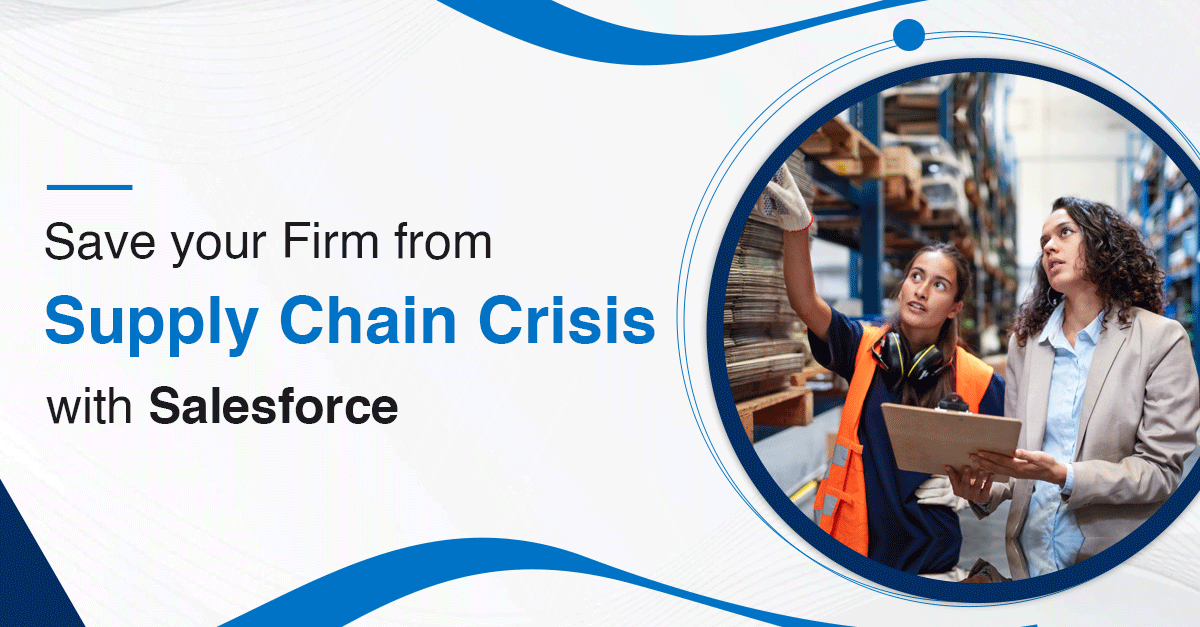
Empty warehouses, unhappy customers, and bare shelves are some issues that manufacturing companies these days have been facing. Even though achieving clear jam-packed ports is not so easy, still, there’s a lot that can be done to improve the situation. You just have to be prepared to save your manufacturing firm from a supply chain crisis and keep growing.
Customers are not concerned about things that are happening behind the scenes. All they want is their product to be available or delivered on time. That’s where you need to work on delivering transparent and proactive service.
We’ve listed here a few ways you can ease the impact of the supply-chain crisis on your customers while keeping up the revenue.
Since the pandemic, manufacturing companies have been facing supply chain issues. This makes it important for businesses to consider disruption to be the new normal.
They can implement Salesforce to leverage new processes, touchpoints, and checkpoints to shape next-generation digital investments.
Digital transformation should focus on including visibility and engagement systems that could help in winning customers’ trust and building customer relationships as a key to future growth.
With Salesforce, teams can focus on sharing data openly across different departments of a company, thus helping to connect data silos.
Maintaining transparency helps suppliers to communicate in-stock components for manufacturers in real-time. Thus, manufacturers would be able to make their decisions faster on production runs and inventory management.
Another way to tackle the supply chain crisis is to deliver proactive service. Consider a situation, a few days before the scheduled delivery date, you receive a text from the distributor that the shipment is delayed. You receive a new guaranteed delivery date, which can be shared with customers.
This may not be the perfect buyer experience but at least your customers don’t have to sit around wondering about their product.
Now suppose, you don’t receive any word about the delay and the product doesn’t arrive at all. Days go by and you receive no word. It will simply lead to customers canceling orders, rather than waiting any more. This makes delivering proactive service important.
You never know when a supply chain crisis can come to hit you. All you can do here is be prepared to save the firm. That’s where Salesforce can prove to be a great help for you.
Get in touch with our certified professionals to get customized Salesforce solutions for manufacturing businesses to manage your supply chain to avoid any delays in production or delivery.
Although there are different kinds of businesses and all of them varied from each other, one thing that’s a common issue is the lineal supply chain. And mostly it is the manufacturing companies that suffer the most from traditional supply chain management. Lack of collaboration between production and supply chain end up leaving a lot of loopholes. But all of the issues can be resolved by integrating production runs and supply chain with Salesforce CRM.
Lack of synchronization between production and supply chain can lead to delays in delivery, and reduced visibility and collaboration between processes. Integrating production runs and supply chains can bring different teams in a manufacturing company together through a centrally managed platform.
Bringing the supply chain and production department in a manufacturing company together is a great way to fill in the gaps between teams, providing everyone the viability of processes in production as well as the supply chain.
To elaborate on this, we have mentioned some benefits of integrating production runs and supply chain with Salesforce.
Salesforce allows keeping communication transparent between internal teams and suppliers. It provides consolidated collaboration, case management for operational issues, and access to supplier self-service portals.
Salesforce integration allows teams to use workflows and automation to create vendor networks that would accelerate the supplier onboarding process. This allows in-house teams to evaluate their needs and look for suppliers according to their requirements.
Using Salesforce, you can easily benchmark and compare supplier analytics with multiple systems of record. You can access actionable insights using AI for supplier stratification and risk recognition, ongoing performance management, and timely monitoring and alerting about the supply chain process.
Connecting production and supply chain would help teams to be updated to their stock and material usage for production. Using analytics teams can forecast the quantity of supply that would be required to keep the production in line. It even helps to plan future product and supply change according to the expected market demand.
Fill in the gap between your production team and supplier with Salesforce that would help you maintain transparency of information on both parts. Salesforce can help to keep the in-house teams and suppliers on the same page to work together and boost business.
Find out more about implementing Salesforce for manufacturing businesses. Contact us to learn more.